Review 3 min read 19+
Depot Review: The Pantograph Stays Up
Ozone first. Grease underneath. Depot announces itself through the nose, long before anyone speaks, and by the time words arrive your chest is already tight.
First impressions
The last consist slides toward the pit, wheels scraping rail in a voice that means tired, and the overhead wire above it is still taut — still live, still faintly singing. There is a spot on your tongue where a spark jumped earlier, metallic and bright, and the pantograph is still up, its collector rope hanging beside the car like an untied thing. This is the opening state of Depot, and it is lovely scene-setting: everything present, everything charged, nothing decided.
Night inspection always starts with this smell — the game teaches you that early, and it is a smart move. You are the night inspector, so the work is real: wheels, wires, joints. A grease tin sits open at the pit edge, a note in blocky handwriting ordering you to pack the joint before it cools. The depot speaks fluent maintenance, and the script will spend the rest of the night proving that desire speaks it too.
What makes it work
Chohui, thirty, is the reason this one sings. A tram driver who doubles as the night mechanic: short bob coming loose at the edges, uniform tie already surrendered to the shift, grease on her hands that she stopped apologizing for years ago. She is competent in a way visual-novel love interests are rarely permitted to be — she reads the car like text, knows which joint is failing by sound alone, and the writing lets that mastery be attractive without ever stopping to comment on it.
Her husband drives another line; his roster hangs in some other depot, and the story mentions him exactly as often as a real night would. Barely. Then, once, pointedly.
The pivot arrives as a single instruction, given without the rope changing hands:
"Lower the pantograph only."
Not the wire. Not the night. The pantograph — which is procedure, which means the car is safe to work on, which means, if you happen to hear the second meaning, that everything else is still up. A safety bulletin and an invitation wearing the same four words is the sharpest trick in the whole script, and the game has the confidence to never explain it.
The empty car becomes the third character. Stay inside it, and it stops being lights-out — windows gone black, seats holding the day's warmth, the wire humming above a car that is technically off duty. Choose, says the game. It refuses to choose for you.
Where it bites
The jargon is dense and proudly unexplained — pantographs, collector ropes, packing joints — and the first twenty minutes can feel like a wall if workshop vocabulary is not your dialect. Pacing is unhurried to a fault; Depot trusts silence the way its depot trusts the wire. But the slow burn is the design, the pit exit stays right where you left it, unglamorous and real, and that is exactly what makes staying mean something.
Heat level
Suggestive throughout, explicit never. The charge is generated by contact — grease passed hand to hand, shared warmth in a closed car, the afterimage of a spark — and when the night finally breaks, it cuts to black with the confidence of someone killing the depot lights. What lingers afterward is not anatomy; it is temperature, ozone, and the sound a live wire makes over an empty street.
Should you play it
Recommended without reservation for anyone who likes romance earned with tools. Depot is a rare encounter VN where both leads are excellent at their jobs and the chemistry is mostly mutual competence finally touching. Whether you walk out through the inspection pit or stay in the empty car, this depot night pays you back — but only one ending hums. And if a note found in the dark is your kind of storytelling, our cellar note story runs the same after-hours current, with plenty more waiting on the encounter shelf.
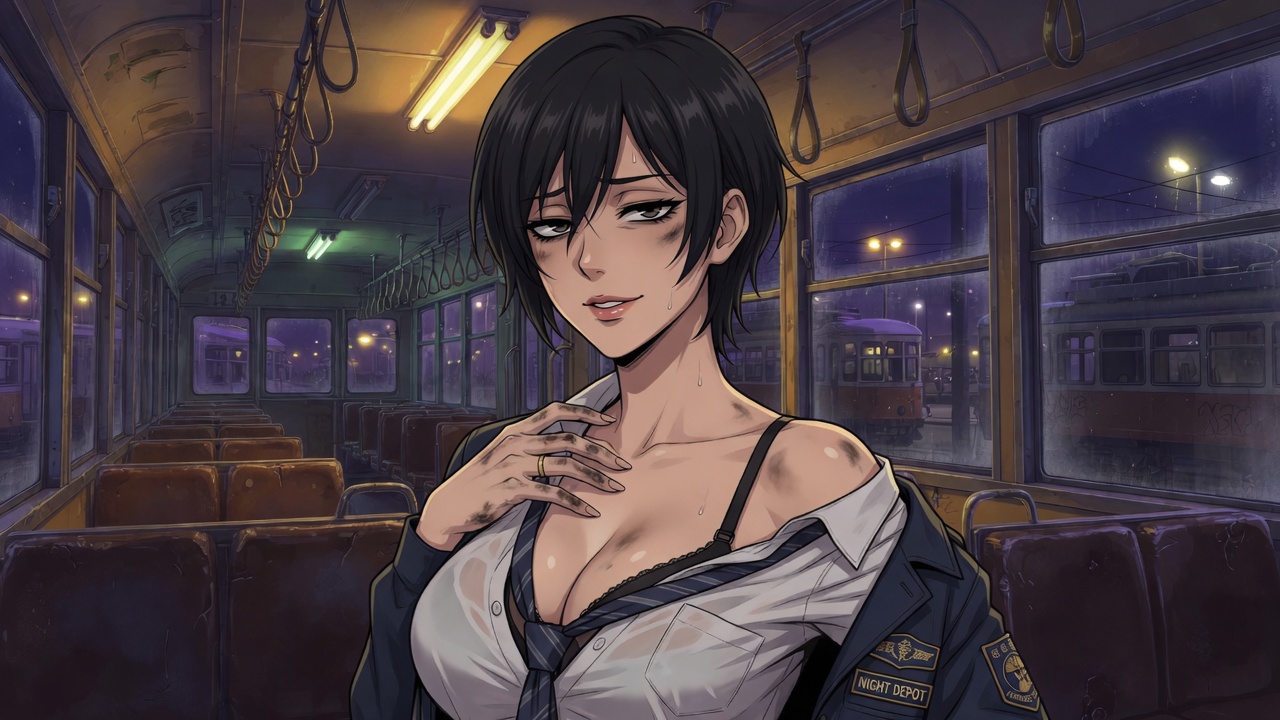
Depot
After the last inbound, the city tram depot. Chohui will not drop the pantograph rope. “Lower the pantograph only.” Walk out through the inspection pit here, and the night is just lights-out.
Every story is completely free to read. No paywall, no account.